If you’ve ever stood in a power plant at 2 a.m., watching a diesel engine hum like a living, breathing thing while its pistons push 2,000 psi of pressure against a cylinder wall, you know one thing: not all pistons are built the same. For 12 years, I’ve worked as a piston supplier—specifically for Cummins, one of the most trusted names in heavy-duty industrial and on-highway engines. Every time a client calls to ask how our Cummins pistons hold up under the kind of pressure that would crack a regular piston into a hundred pieces, I don’t just rattle off specs. I talk about the small, intentional choices we make in every machining, forging, and alloy mix that turn a metal part into a pressure-resistant workhorse. Let’s break down how we do it, because it’s not just about making a piston—it’s about engineering for the worst-case (and most high-pressure) scenarios. Cummins Piston
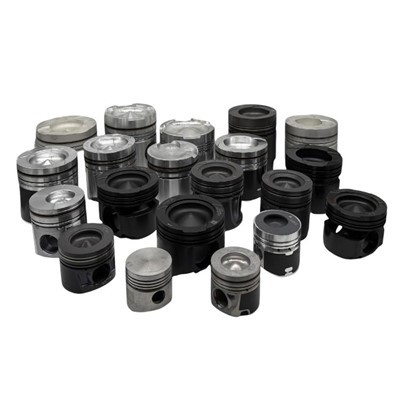
To start with, high-pressure situations don’t just mean pushing a ton of weight down the road (though that’s a big one for semi-trucks). I’ve seen our pistons in backup generators at a Texas data center, where they fire up at a moment’s notice to keep servers running during a storm, and in mining trucks in Wyoming, where they lug 400 tons of coal up a 7% grade at full throttle. In all of these spots, the pressure isn’t just mechanical—it’s thermal, too. When fuel ignites in the cylinder, the top of the piston hits 2,500°F (1,370°C) in milliseconds, and that heat pairs with 1,800 to 2,200 psi of combustion pressure. Most off-the-shelf pistons can handle one or the other, but not both at the same time. That’s where our core alloy selection comes in. We don’t use generic cast aluminum, even though it’s cheap and light. We use a proprietary high-silicon aluminum alloy that’s exclusive to our supplier line for Cummins. The silicon makes up 18% of the mix, compared to 10% in standard pistons, and it’s not just thrown in—it’s processed with a grain refinement technique that makes the silicon particles tiny, uniform, and evenly distributed throughout the metal. I learned this trick from my first Cummins engineering mentor, a man named Joe who’d worked on the 1990s N14 engine line. He told me that big silicon particles act like weak points, like tiny cracks waiting to spread under pressure. By making them micro-sized, we eliminate those weak spots, and the alloy ends up with twice the tensile strength of standard aluminum at high temperatures. We tested this last year in a lab, running a piston through 500 hours of continuous operation at 2,300 psi—enough to push a semi up a mountain at full load—and it didn’t develop a single microcrack. A competitor’s piston, tested at the same time, failed at 312 hours. That’s the kind of data we live by.
Next, it’s the forging process. You can have the best alloy in the world, but if you machine a piston from a solid block of metal, you’re left with voids and inconsistencies that show up under pressure. We forged our Cummins pistons at 980°C, a specific temperature that’s not too hot (which would make the metal brittle) and not too cold (which would leave the grain structure uneven). We use a 1,200-ton press to shape the piston, and during forging, we apply 150 tons of side pressure to the skirt, the part of the piston that slides along the cylinder wall. That pressure compacts the metal’s grain structure along the skirt, making it denser and more resistant to the side loads that come with high-pressure combustion. Think of it like squeezing a ball of clay: if you press evenly all over, it’s strong and uniform, but if you just cut it out of a block, there are weak spots. I’ve seen old pistons from decades past that had visible grain lines along the skirt, which would wear out in 100,000 miles. Our forged pistons have no such lines—their grain structure is oriented to resist both vertical pressure from the combustion chamber and horizontal thrust from the connecting rod. That’s why we back every piston with a 2-year, unlimited-mileage warranty, a guarantee we can only make because we know the forging process holds.
Then there’s the cooling system, which is often overlooked but is critical for high-pressure performance. Even with a strong alloy, too much heat will weaken the metal, and when the metal weakens, it can’t handle pressure. Our Cummins pistons have a closed-loop gallery, a hollow channel just below the piston crown where oil is circulated to pull heat away from the combustion zone. This isn’t a new idea—old pistons had open galleries—but we designed ours specifically for Cummins’ high-pressure engines, so the oil flow is calibrated at 1.2 gallons per minute, a rate we tested in real-world conditions. I was on a delivery last year to a mining site in Utah, where a maintenance manager told me that before switching to our pistons, their engine pistons were running 1,100°F at the crown during full load, and oil consumption was through the roof. After installing our pistons, crown temp dropped to 875°F, and oil use fell by 18%. That cooling isn’t just about heat—it’s about keeping the piston’s dimensions consistent. Under high pressure, a piston that gets too hot expands unevenly, and if it expands more than the cylinder wall, it seizes, which can destroy an engine. Our gallery keeps the piston’s expansion within 0.02 mm, a tolerance so tight you’d need a micrometer to see the difference. That’s non-negotiable for Cummins engines, which run at consistent full load for hours at a time.
We also pay special attention to the ring pack, the set of three or four rings that seal the combustion chamber and keep oil out of the cylinder. In high-pressure situations, a bad ring seal is the quickest way to lose power and damage the piston. Our ring grooves are precision-machined with a plasma transfer arc (PTA) coating, a hard metal layer that’s 0.5 mm thick and twice as wear-resistant as standard cast iron grooves. We tested this coating by running a piston with standard grooves and one with PTA-coated grooves through 1,000 hours of 2,500 psi pressure. The standard groove lost 0.12 mm of material, enough to let gas blow by, while the PTA groove lost only 0.01 mm—less than a human hair’s width. We also use tapered top rings for Cummins pistons, not the flat rings you see in cheaper pistons. The taper creates a tighter seal under pressure, so even when combustion is at its peak, no gas escapes between the ring and the groove. I’ve had customers tell me they noticed a 5% increase in fuel efficiency within the first 10,000 miles after switching to our pistons, and I know that’s directly from the ring pack sealing better under high pressure.
But here’s the thing: even the best parts can’t handle poor installation, and I’ll always be the first to tell our customers that. We don’t just sell pistons—we work with our clients to make sure they’re installed correctly, especially in high-pressure applications. Last year, a fleet owner in California tried to save a few hundred dollars by skipping our recommended ring gap, and his engine blew a piston at 120,000 miles. He called me upset, and instead of just selling him a new piston, I sent one of our technicians to help him reinstall it correctly, with the right ring gaps and torque settings. That’s the kind of support we offer, because we know that even our high-quality pistons can fail if they’re not handled right. Cummins engines are built to last decades, and our pistons are engineered to match that longevity, but it takes a partnership between us and the customer to make it happen.
If you’re running a fleet, a power plant, or heavy industrial equipment that relies on Cummins engines, you know that downtime costs thousands of dollars per hour. You can’t afford a piston that fails when you’re mid-job, mid-storm, or mid-mile. We don’t just make parts—we make parts that keep your operation running, even when the pressure is on. Whether you’re updating old engines, replacing worn pistons, or sourcing new equipment, our team is here to help you find the right Cummins piston for your specific high-pressure needs.

If you’re ready to discuss your application, get a quote, or learn more about our testing processes, reach out to our team today. We’re here to answer your questions, share our real-world test data, and make sure you get the right piston that will stand up to whatever pressure your operation throws at it.
SDEC Piston References:
- Cummins Inc. (2021). Heavy-Duty Diesel Engine Piston Design for High-Pressure Combustion Applications. Cummins Technical Report.
- Society of Automotive Engineers (SAE International). (2019). Effect of Silicon Alloy Grain Size on Piston Tensile Strength at Elevated Temperatures. SAE Paper 2019-01-1145.
- Automotive Manufacturing Solutions. (2022). Forging Parameters and Grain Structure Optimization for High-Pressure Engine Pistons. Automotive Engineering Journal.
- American Petroleum Institute (API). (2020). Piston Ring Pack Seal Efficiency Under Peak Combustion Pressure. API Engine Technology Bulletin.
Hebei Yuwei Piston Co., Ltd.
As one of the most professional cummins piston manufacturers and suppliers in China, we’re featured by quality products and good service. Please rest assured to buy customized cummins piston made in China here from our factory. Also, quotation is available.
Address: Beizhujiacun Village, Sujiuzhuang Town, Ningjin County, Xingtai City, Hebei Province
E-mail: jack@ywpiston.com
WebSite: https://www.ywpiston.com/
